ARIF CEKDERI
From 19/10/2026 to 01/11/2026
CHORDATA RESIDUUM
Ph.D. Arif Çekderi
More infos
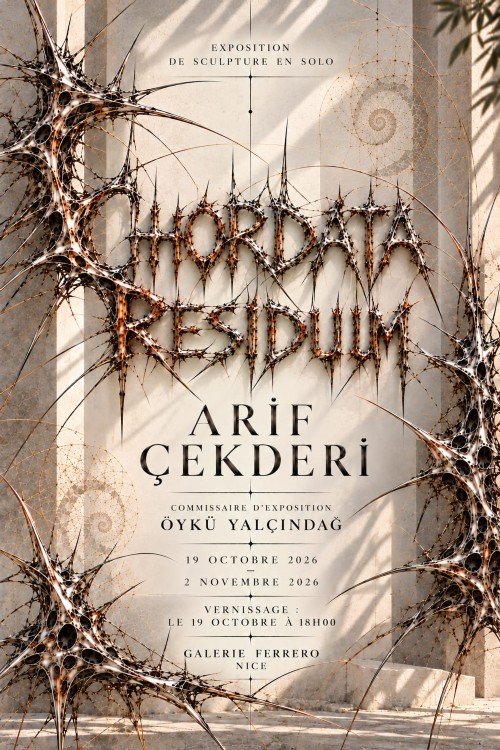
Chordata Residuum, a solo exhibition by Dr. Arif Çekderi, curated by OYKU YALCINDAG, will be on view from 19 October to 1 November 2026 at Galerie Ferrero in the historic centre of Nice. Bringing together wearable, kinetic, and wall-mounted sculptures, the exhibition explores the human body, mechanisms of defence, and the struggle for self-reliance in a world shaped by social competition and existential uncertainty.
Drawing on paleontological imagery, bodily modification, and industrial fabrication, Çekderi develops a sculptural language that brings human anatomy into dialogue with the physical characteristics of prehistoric predators. From Smilodon skulls and hyena jaws to porcupine-spiked helmets and wearable T-Rex footwear, his works transform animal features into unconventional forms of bodily protection, evoking the instinctive strategies through which living beings defend themselves and establish their boundaries.
The title combines Chordata, the biological phylum encompassing vertebrates, with Residuum, meaning that which remains. The spine occupies a central place in the exhibition, functioning both as an anatomical structure that sustains the body against gravity and as a point of departure for considering human consciousness within an indifferent universe. The works address the tensions between biological inheritance, psychological defence, and the pressures of contemporary social competition.
Materiality is fundamental to Çekderi’s practice. Using cold industrial metal and precise fabrication techniques, he creates rigid, uncompromising forms that resist organic warmth and emotional sentimentality. The material also evokes the cosmic origins of matter, extending the exhibition’s scope beyond the individual body to questions of existence, permanence, and survival. In combination with prehistoric references and mechanical forms, the sculptures occupy a space between the organic and the artificial, instinct and construction.
Through this distinctive sculptural language, Chordata Residuum examines how bodily form, protective structures, and animal references intersect with the conditions of contemporary life, inviting viewers to consider the complex relationship between the body and its surrounding environment.


 GEMEA INTERACTIVE
